The Gateway Links the Systems
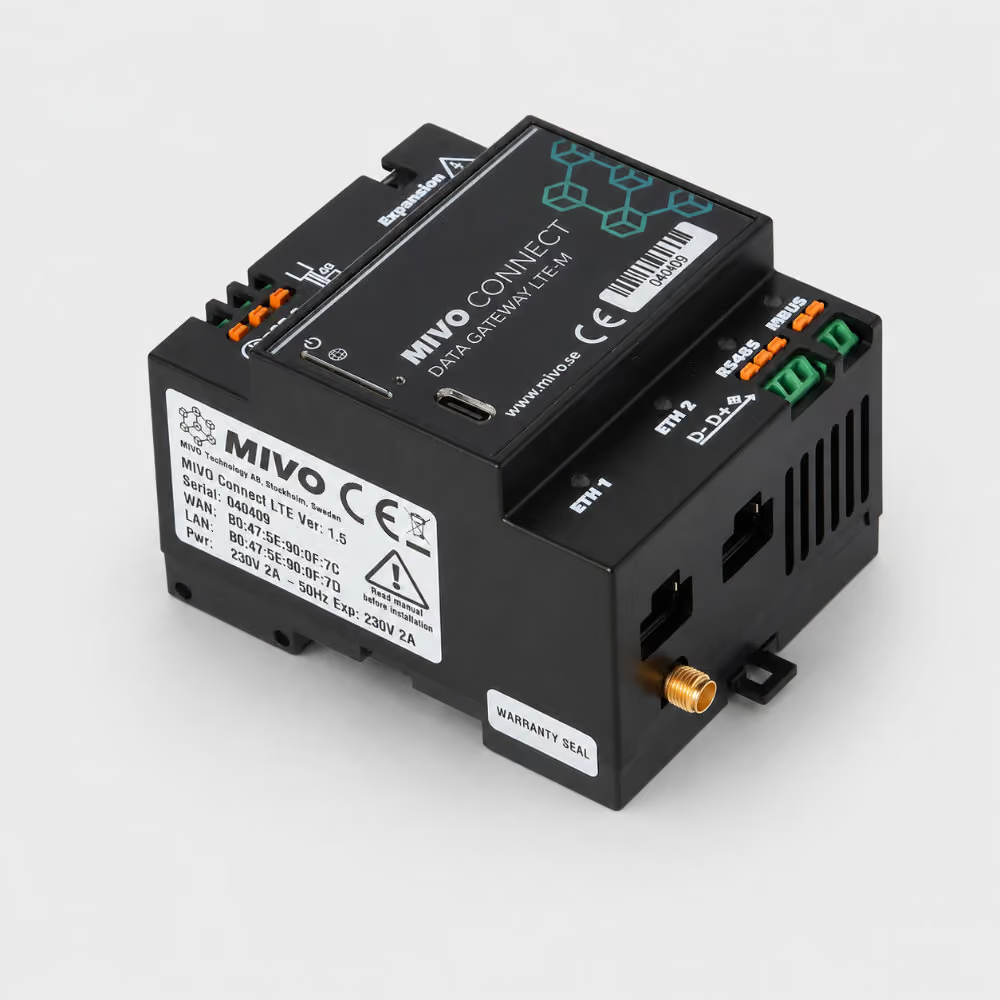
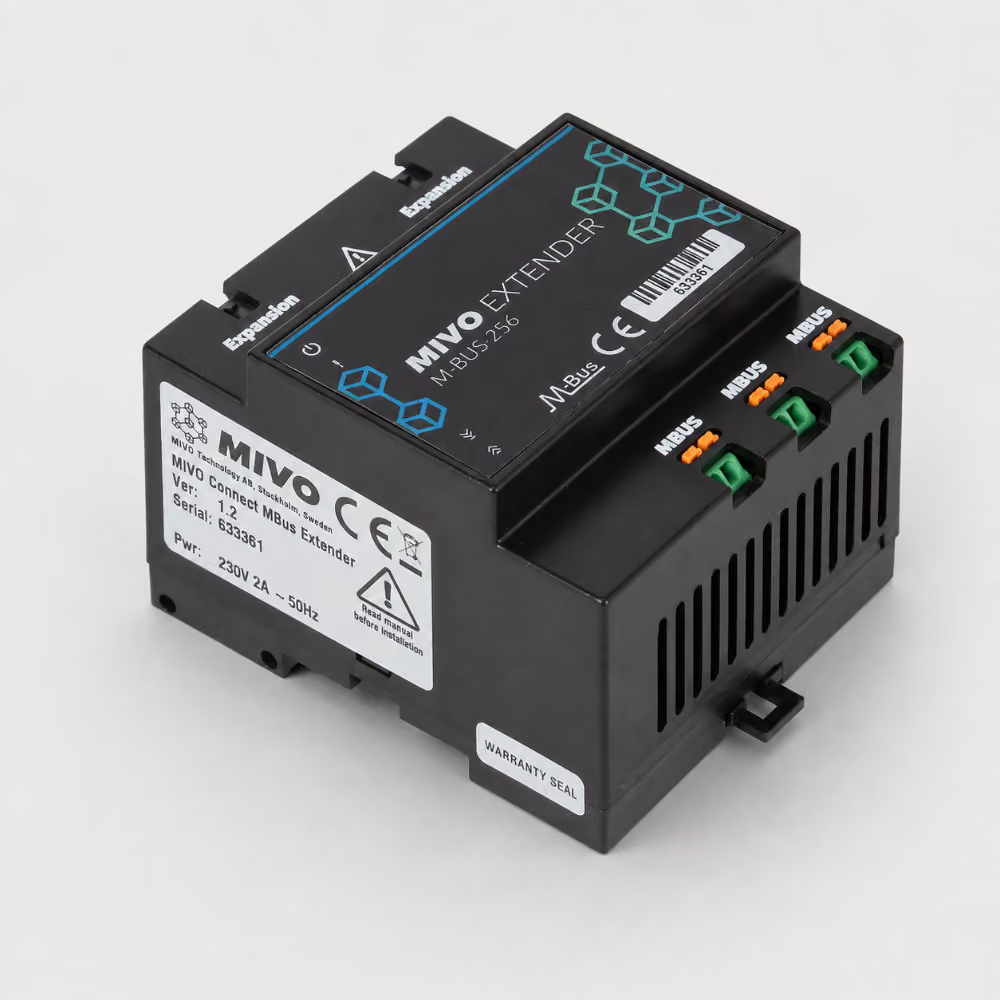
A gateway needs to handle both local meter data collection and communication with the server. For wired M-Bus, it may have a built-in M-Bus master or use an external converter.
When choosing a gateway, support for M-Bus and LTE-M is only part of the picture. It must also be able to interpret the data from the specific meters and deliver it in a format the receiving system understands.
Useful features may include:
- Scheduled readings from meters and sensors.
- Local storage during cellular communication outages.
- Automatic transmission of stored readings when the connection is restored.
- Remote configuration and software updates.
- Monitoring of communication errors and missing readings.
Support for these features varies between products and should be checked in the gateway’s documentation.
Wired M-Bus and Wireless M-Bus
M-Bus is available both as a wired communication system and as Wireless M-Bus, which transmits meter data by radio.
With wired M-Bus, meters connect to a shared two-wire bus. The M-Bus master can also supply power to the meters’ communication interfaces. The number of devices that can be connected depends on factors such as the master’s capacity, the load presented by the meters and the cable network’s design.
Wireless M-Bus can be useful where installing cables is difficult or where meters already have radio transmitters. The gateway then needs a compatible radio receiver and support for the communication modes and any encryption keys in use.
In both cases, the principle is the same: meter data is collected locally and transmitted through the gateway’s LTE-M connection.
Why Use LTE-M for Data Transmission?
Meter data collection often involves relatively small amounts of data sent at scheduled intervals. This suits LTE-M, which is designed for applications such as monitoring and periodic reporting from IoT devices.
A cellular connection allows the gateway to be installed wherever suitable LTE-M coverage is available, without connecting it to the building’s local data network. This can simplify installation in plant rooms, heating substations and smaller facilities.
LTE-M also includes features that extend coverage under weak signal conditions. Even so, the connection should be tested at the installation site. Walls, basements and metal cabinets can affect communication, and antenna placement can make a significant difference.
Reading Intervals and Transmission Intervals Are Different
The gateway does not need to send information to the server every time it reads a meter.
For example, it could read the meters every fifteen minutes, store the readings and transmit them together once an hour. This provides detailed historical data while limiting the number of cellular transmissions.
The appropriate intervals depend on how the information will be used:
ApplicationRequirements That Determine Data CollectionConsumption monitoringRegular readings and comparable historical dataBillingReliable readings at specified timesOperational monitoringMore frequent updates of relevant measurementsAnomaly detectionIntervals short enough to detect changes
An alarm can only be sent once an anomaly has been detected. If the gateway reads a meter once an hour, it may therefore be unable to report a change sooner, even when the cellular connection is available.
Power Consumption Applies to the Entire Installation
LTE-M supports the power-saving features PSM and eDRX. These allow the cellular modem to sleep between communication sessions, but they also affect how quickly the gateway can receive messages from the server. During PSM, the modem cannot be reached by the network; with eDRX, it checks for incoming communication at longer intervals.
For a gateway, power requirements must be assessed for the complete product. The M-Bus interface, processor, local storage and any radio receivers also consume energy. If the gateway powers a wired M-Bus network, that also affects the power supply requirements.
Low power consumption in the cellular modem therefore does not automatically mean that the entire installation is suitable for battery operation.
What Should Be Checked Before Installation?
For the solution to work, all parts need to be compatible: the meters, the M-Bus network, the gateway, the cellular connection and the receiving system.
In particular, check that the gateway can read the specific meters, that measurement units and scaling are interpreted correctly, and that the receiving system can accept the information. Timestamps and the handling of missing or duplicate readings are also important for maintaining useful historical data.
LTE-M coverage and subscription support must be verified. Standard 4G coverage does not automatically mean LTE-M is available for the selected device and operator.
Communication with the server should also be protected using appropriate encryption and authentication. Support for secure updates and access control is part of maintaining the solution over its lifetime.
From Local Readings to Useful Meter Data
M-Bus and an LTE-M-connected gateway allow multiple meters and sensors to be brought together in a single solution. M-Bus handles communication close to the measurement points, while LTE-M carries the information to the systems where it will be used.
This enables automatic data collection and ongoing monitoring without manual meter readings. When collection intervals, storage and transmission are matched to operational needs, the readings can provide a better basis for managing both operations and resource consumption.